



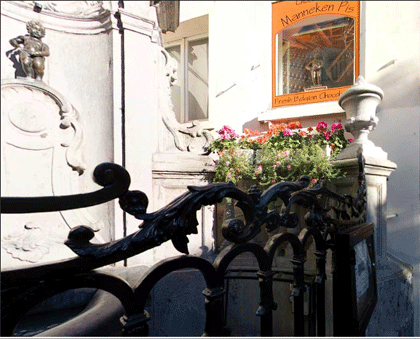
Location:
History and Legends:
Another legend states that in the 14th century, Brussels was under siege by a foreign power. The city had held its ground for some time, so the attackers conceived of a plan to place explosive charges at the city walls. A little boy named Julianske happened to be spying on them as they were preparing. He urinated on the burning fuse and thus saved the city. There was at the time (middle of the 15th century, perhaps as early as 1388) a similar statue made of stone. The statue was stolen several times. In 1619 it was replaced by the current bronze statue, created by Franco-Flemish Baroque sculptor Jerome Duquesnoy, father of the more famous François of the same last name.
Another story (told often to tourists) tells of a wealthy merchant who, during a visit to the city with his family, had his beloved young son go missing. The merchant hastily formed a search party that scoured all corners of the city until the boy was found happily urinating in a small garden. The merchant, as a gift of gratitude to the locals who helped out during the search, had the fountain built.
Another legend was that a small boy went missing from his mother when shopping in the centre of the city. The woman, panic-stricken by the loss of her child, called upon everyone she came across, including the mayor of the city. A city-wide search began and when at last the child was found, he was peeing on the corner of a small street. The story was passed down over time and the statue erected as tribute to the well known fable.
Another legend tells of the young boy who was awoken by a fire and was able to put out the fire with his urine, in the end this helped stop the king's castle from burning down.
Traditions:
Although the proliferation of costumes is of twentieth-century origin, the occasional use of costumes dates back almost to the date of casting, the oldest costume on display in the City Museum being of seventeenth-century origin. The changing of the costume on the figure is a colourful ceremony, often accompanied by brass band music. Many costumes represent the national dress of nations whose citizens come to Brussels as tourists; others are the uniforms of assorted trades, professions, associations, and branches of the civil and military services.
On occasion, the statue is hooked up to a keg of beer. Cups will be filled up with the beer flowing from the statue and given out to people passing by.
The statue has been stolen seven times, the last time being the 20th century by students from the village of Broxeele, a town with the same etymology as Brussels.
There is also a statue of Manneken Pis in Tokushima, Japan, which was a present from the Belgian embassy (Tokushima being twinned with Brussels).
Since 1987, the Manneken has had a female equivalent, Jeanneke Pis, located on the east side of the Impasse de la Fidélité / Getrouwheidsgang.
Replicas:
In September 2002, a Belgian-born waffle-maker in Florida, named Assayag, set up a replica in front of his waffle stand in the Orlando Fashion Square mall in Orlando, Florida. He recalled the legend as 'the boy who saved Brussels from fire by extinguishing it with his urine' (confusing the legend with an incident in Gulliver's Travels perhaps). Some shocked shoppers made a formal complaint. Mall officials said that the waffle-shop owner did not follow procedures when he put up the statue and was therefore in violation of his lease.
In contrast, there is a similar statue in Rio de Janeiro in front of the quarters of Botafogo de Futebol e Regatas, a famous football club from Brazil. There, the presence of the statue is taken lightly, and it has even been adopted as a mascot by the club. Fans usually dress it with the club's jersey after important wins.
In the Netherlands, there is a small chain of chip shops called Manneken Pis.
In Olney, Maryland, there is a Belgian restaurant called Mannequin Pis.
A working replica of Manneken Pis stands on the platform of Hamamatsuchō Station in Tokyo, Japan. The statue is a great source of pride for station workers who dress it in various costumes—traditional and otherwise—at different times of year.