


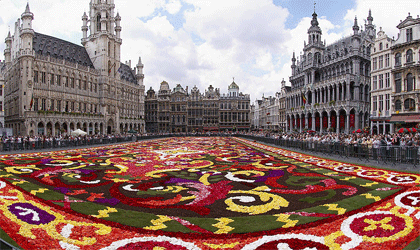
The Grand Place (French, pronounced: [ɡʁɑ̃ plas]; also used in English) or Grote Markt
 listen
(help·info)
(Dutch)
is the central square of
Brussels. It is surrounded by guildhalls,
the city's Town Hall, and the Breadhouse (French: Maison du
Roi, Dutch: Broodhuis). The square is the most important
tourist destination and most memorable landmark in Brussels, along
with the
Atomium and
Manneken Pis. It measures 68 by 110 metres (223 by 360 ft), and
it is a
UNESCO
World Heritage Site.
listen
(help·info)
(Dutch)
is the central square of
Brussels. It is surrounded by guildhalls,
the city's Town Hall, and the Breadhouse (French: Maison du
Roi, Dutch: Broodhuis). The square is the most important
tourist destination and most memorable landmark in Brussels, along
with the
Atomium and
Manneken Pis. It measures 68 by 110 metres (223 by 360 ft), and
it is a
UNESCO
World Heritage Site.History:
The market likely developed around the same time as the commercial development of Brussels. A document from 1174 mentions a lower market (Latin: forum inferius) not far from the port on the Senne river. The market was well situated along the Steenweg (Dutch: Causeway), an important commercial road which connected the prosperous regions of the Rhineland and the County of Flanders.
At the beginning of the 13th century, three indoor markets were built on the northern edge of the Grand Place; a meat market, a bread market and a cloth market.[2] These buildings, which belonged to the Duke of Brabant, allowed the wares to be showcased even in bad weather, but also allowed the Dukes to keep track of the storage and sale of goods, in order to collect taxes. Other buildings, made of wood or stone, enclosed the Grand Place.
The Brussels City Hall was built on the south side of the square in stages between 1401 and 1455, and made the Grand Place the seat of municipal power. It towers 96 metres (315 ft) high, and is capped by a 3 metre (12 ft) statue of Saint Michael slaying a demon. To counter this symbol of municipal power, from 1504 to 1536 the Duke of Brabant built a large building across from the city hall as symbol of ducal power. It was built on the site of the first cloth and bread markets, which were no longer in use, and it became known as the King's House (Middle Dutch: 's Conincxhuys), although no king has ever lived there. It is currently known as the Maison du roi (King's House) in French, though in Dutch it continues to be called the Broodhuis (Breadhouse), after the market whose place it took. Wealthy merchants and the increasingly powerful guilds of Brussels built houses around the edge of the square.
On August 13, 1695, a 70,000-strong French army under Marshal François de Neufville, duc de Villeroi began a bombardment of Brussels in an effort to draw the League of Augsburg's forces away from their siege on French-held Namur in what is now southern Belgium. The French launched a massive bombardment of the mostly defenseless city centre with cannons and mortars, setting it on fire and flattening the majority of the Grand Place and the surrounding city. Only the stone shell of the town hall and a few fragments of other buildings remained standing. That the town hall survived at all is ironic, as it was the principal target of the artillery fire.
In the late 18th century, revolutionaries sacked the Grand Place, destroying statues of nobility and symbols of Christianity. The guildhalls were seized by the state and sold. The buildings were neglected and left in poor condition, with their façades painted, stuccoed and damaged by pollution. In the late 19th century, mayor Charles Buls had the Grand Place returned to its former splendour, with buildings being reconstructed or restored.
The Grand Place continued to serve as a market until November 19, 1959, and it is still called the Grote Markt or Great Market in Dutch. Neighbouring streets still reflect the area's origins, named after the sellers of butter, cheese, herring, coal and so on. The Grand Place was named by UNESCO as a World Heritage Site in 1998. One of the houses was owned by the brewers' guild, and is now the home of a brewers' museum.
Flower Carpet:
External Links: