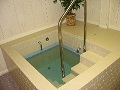


This was the synagogue whose geniza or store room was found in the 19th century to contain a treasure of abandoned Hebrew secular and sacred manuscripts. The collection, known as the Cairo Geniza, was brought to Cambridge, England at the instigation of Solomon Schechter.
Etz Chaim Synagogue, Cairo.
Haïm Capoussi Synagogue, Cairo
Ibn Maïmoun Synagogue, Cairo
Early History:
After his death in Fustat on December 12, 1204, it is believed that he was buried for a short while at the synagogue before being reinterred in Tiberias. According to tradition, his bones were placed for a week in a small shrine where he used to study and to heal strangers. (Some believe his bones never left Egypt.)
19th century: Rebuilding
In the 19th century, another synagogue was built on the site and named in his honor
20th century: Disuse and decay
The situation of Egypt's Jews became increasingly precarious in the middle of the 20th century. Rising Arab nationalism, together with increased tensions between Jews and Arabs following the 1948 Arab-Israeli War and later, the 1956 Suez War, led to government restrictions on foreign economic activity which deeply impacted Egypt's Jewish community. Several thousand Jewish residents were expelled from the country following the 1956 war and thousands more fled the hostile social and economic conditions. Egypt's Jewish population eventually dropped from 80,000 to less than 100.
With only about 30 Jews (mostly elderly women) left in Cairo, the synagogue was closed, and almost collapsed due to underground water and earthquakes.The ceiling of the building collapsed in 1992, and the debris was left on the floor. The slum area in which synagogue was located was littered with garbage. The head of the Supreme Council of Antiquities, Zahi Hawass, said that the synagogue was used for the last time in 1960, and then was allowed to "crumble". Although it was declared an antiquity in 1986, the condition of the medieval synagogue had deteriorated further by 2005. A holy ark with a broken door was located in the small courtyard, covered with debris. The ark's Star of David was still present, but was hanging on only by a thread.
21st century: Restoration
Inauguration controversy
On March 14, 2010 the official inauguration ceremony was canceled. Zahi Hawass explained that the cancellation was due to media reports of Jews "dancing and drinking alcohol in the synagogue" during the private March 7 dedication, which Hawass described as a "provocation to the feelings of hundreds of millions of Muslims in Egypt and around the world". Hawass later added that the decision to scrap the ceremony was made at "a time when Muslim holy sites in occupied Palestine face assaults from Israeli occupation forces and settlers...". Later still, he characterized the cancellation of the ceremony as a "strong slap in the face" to "the Zionist enemy."
Legends and tradition
The synagogue and accompanying yeshiva have traditionally been considered to have miraculous healing powers. Until the Egyptian government forbade the practice in 1948, the synagogue was used as a place of healing by the local Jewish community. The ailing person was left to sleep in the special underground room in the hope that the sufferer would dream of Maimonides and get better.
Meir'enaim Synagogue, Cairo
Moussa Dar'i Synagogue, Cairo
Pahad Itzhak Synagogue, Cairo
Sha'ar Hashamayim Synagogue , Cairo

Shaar HaShamayim Synagogue, 17 Adly
Street, Ismailia. Active on High Holidays. Architect: Maurice
Youssef Cattaui. Completed: 1899. Photo:
Daniel Mayer, July 2008
Its long time leader was Chief Rabbi Chaim Nahum. In 2008, the synagogue marked its 100th anniversary. The synagogue was built in a style evoking ancient Egyptian temples, and was once the largest building on the boulevard.
When the synagogue opened in 1899, there was a vibrant Jewish community in Cairo. The last time the synagogue was full was in the 1960s. Today the community numbers 30-40 members, most of them older women.
Although it is considered a Sephardic synagogue, many Ashkenazi Jews were members of the congregation and contributed to its construction and upkeep.
In February 2010, a booby-trapped suitcase was hurled at the synagogue from a nearby hotel. The suitcase caught fire, but no one was hurt and no damage was reported.
Vitali Madjar Synagogue, Cairo